
 Henry Miller's politically incorrect genius (pig) weighs heavily on my cyber tongue. And so I ask you, with Henry Miller pig on the brain and in my veins:
Do you spit or swallow-- your Life?
Do you nonchalantly suck on it, lick it, or butterfly kiss it?
Or do you finger fuck your throat and flush it down?
Or do you just look at it?
Your bullshit life.
_________________________
Years ago I tainted the original Brassai "Paris Prostitute..." photo with the lyrics of the Andrew Sisters, and added a pair of red, fuck-me-pumps. This photo has been tainted without permission. It's about time Brassai and Miller made out on this blog.
Speaking of bullshit, there's no particular reason for choosing this passage from Tropic of Cancer, other than it's one of many worth reading, again:
"Going back in a flash over the women I've known. It's like a chain which I've forged out of my own misery. Each one bound to the other. A fear of living separate, of staying born. The door of the womb always on the latch. Dread and longing. Deep in the blood the pull of paradise. The beyond. Always the beyond. It must have all started with the navel. They cut the umbilical cord, give you a slap on the ass, and presto! you're out in the world, adrift, a ship without a rudder. You look at the stars and then you look at your navel. You grow eyes everywhere-- in the armpits, between the lips, in the roots of your hair, on the soles of your feet. What is distant becomes near, what is near becomes distant. Inner-outer, a constant flux, a shedding of skins, a turning inside out. You drift like that for years and years, until you find yourself in a dead center, and there you slowly rot, slowly crumble to pieces, get dispersed again. Only your name remains."
--Going back to all the men and lives I've known--


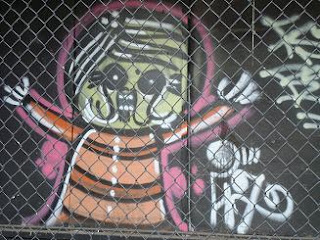
 Arguably, graffiti and tagging are industrial versions of sand mandalas. Stenciled works of art and free hand tags often disappear overnight under whitewash and graffiti fighting technology. Once the ownership realm detects a "defacement of property" the grim beauty inevitably disappears. What are my motives behind photographing temporary urban art? What is gained, and what is lost, in the act of photographing graffiti?




 Posts
Posts


